
Two Russian Tu-22M3 supersonic bombers, escorted by around ten Su-30 and Su-35 fighter jets, were intercepted by NATO aircraft over the Baltic Sea on Monday, April 20, 2026, marking another episode in a recurring pattern of aerial encounters between Moscow and the alliance.
The Russian aircraft flew for approximately four to five hours over neutral waters, according to conflicting statements from Moscow and NATO allies. Russian defence officials confirmed the flight but denied any violation of international airspace rules, stating via Telegram that all operations were conducted in strict compliance with global regulations. They did not respond to follow-up inquiries on Tuesday.
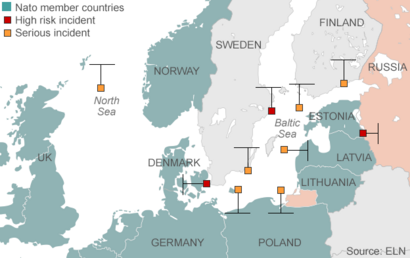
NATO’s response was coordinated by a French unit stationed at the Lithuanian airbase in Šiauliai. Fighter jets from France, Sweden, Finland, Poland, Denmark and Romania were scrambled to monitor and identify the Russian formation. A French journalist embedded with the unit reported that Rafale crews were already on standby, rushed to their hangars in full gear, and took off after engine start-up once clearance was given.
Footage released by Russia showed Swedish JAS 39 Gripen jets initially tracking the bombers as they approached Swedish airspace. As the formation moved toward the Danish-controlled airspace near Bornholm, Danish F-35A fighters assumed the interception role, with one clearly visible in the Russian video. Sweden later described the interception as a routine measure designed to protect its territorial integrity and that of its allies.
Lithuanian defence officials noted that between April 13 and 19, NATO aircraft had already scrambled four times to intercept Russian flights that violated airspace protocols — including instances where transponders were turned off and flight plans were not filed. NATO’s air command declined to comment on the latest incident when asked on Tuesday.
The recurring nature of these intercepts suggests a tested procedure on both sides: Russia launches long-range bomber flights near NATO borders, often with fighter escorts, while alliance jets scramble to visually identify and shadow the aircraft without engaging. Despite the routine characterisation by officials, each incident carries inherent risk of miscalculation, particularly when transponders are disabled or flights deviate from filed plans — actions Lithuania has previously cited as violations.
Russia’s decision to film and release its own cockpit footage adds a psychological dimension to the standoff, showcasing its ability to operate near alliance borders while documenting NATO’s response. This self-publication contrasts with the alliance’s typically quieter handling of such events, though national contributors like Sweden and Denmark have begun confirming their roles in intercepts through official channels.
Why did Russia fly bombers so close to NATO airspace?
Russia stated the flight was a routine training exercise conducted in accordance with international rules, consistent with its claim that all flights follow regulatory standards. NATO and Baltic states have previously viewed similar flights as strategic signalling, particularly when conducted without transponders or flight plans.

How does NATO typically respond to such flights?
NATO scrambles fighter jets from nearby bases to intercept, identify and monitor Russian aircraft, often coordinating across national contingents. In this case, a French-led unit at Šiauliai directed the response, with jets from six alliance members participating in the visual escort and documentation of the formation.


