
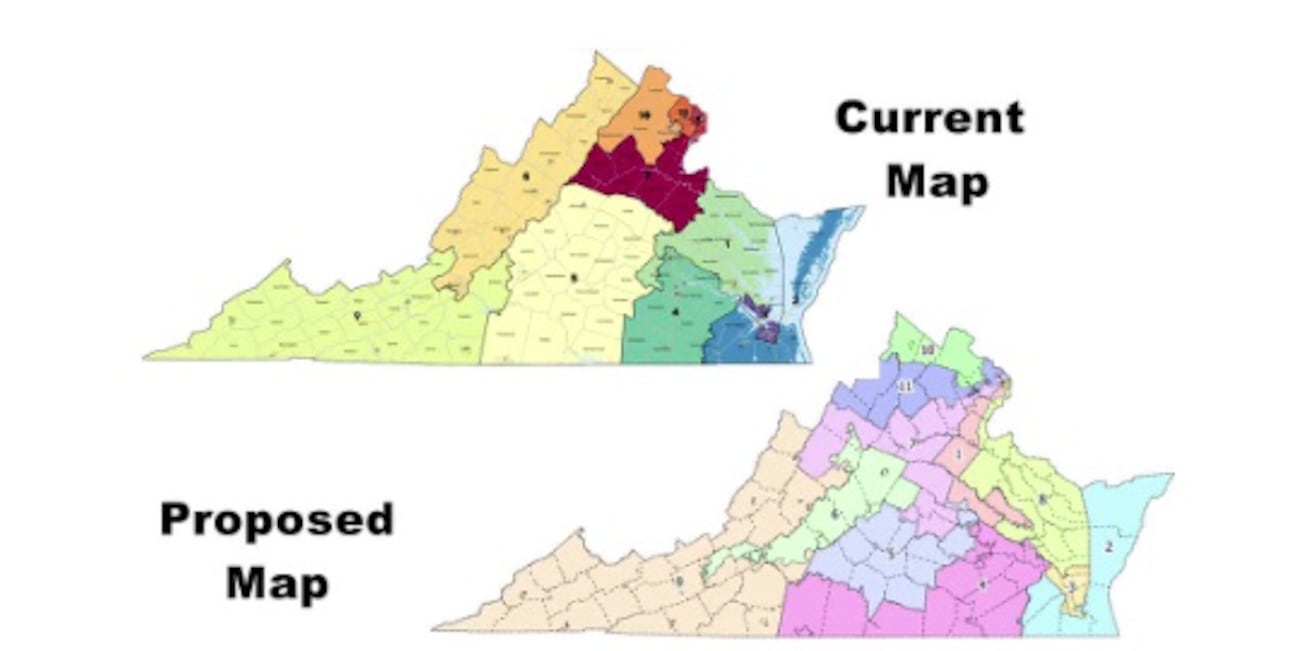
On Tuesday, voters in Virginia approved a ballot measure allowing state authorities to redraw congressional district lines ahead of the 2030 redistricting cycle, a decision that could shift four House seats to Democrats.
The referendum result prompted an immediate reaction from former President Donald Trump, who took to his Truth Social platform to allege election manipulation. “Last night a rigged election took place,” Trump wrote, claiming Republicans had led throughout the day before a sudden influx of mail-in ballots reversed the outcome.
Trump as well criticized the ballot language as intentionally confusing and misleading, urging the U.S. Department of Justice to intervene and correct what he described as a “justice” travesty. His claims echoed familiar rhetoric from previous elections, particularly his repeated assertions about fraud in mail-in voting.
The vote in Virginia represents a significant development in the ongoing partisan battle over congressional mapmaking. Republicans currently hold a narrow majority in the U.S. House of Representatives, and the redistricting process following the 2030 census could determine whether Democrats gain enough seats to challenge that control during the second half of Trump’s current term.
Both major parties have engaged in gerrymandering — the practice of drawing electoral districts to favor one party — though Republicans have employed it more aggressively in recent cycles. By concentrating Democratic voters into a few districts or spreading them thinly across many, parties can maximize their electoral advantage even without winning a majority of the overall vote.
For more on this story, see Virginia Democrats approve redistricting map to gain advantage in 2026 midterms.
In the past year, Trump has urged Republican-led states to preemptively redraw district lines to protect the GOP’s slim House majority, triggering a competitive rush among states to act first. Virginia had been viewed as one of the last major opportunities for Democrats to counteract Republican gains through redistricting before the 2026 midterm elections.
The outcome now shifts momentum toward Democrats, who could use the recent map to secure additional representation in Washington. However, the final district boundaries will not be drawn until after the 2030 census, meaning the full impact of the referendum will not be felt for several years.
Legal challenges are possible, given Trump’s call for federal intervention, though no lawsuit has been filed as of yet. For now, the vote stands as a rare instance of direct voter involvement in a process typically controlled by state legislatures and independent commissions.
What does the Virginia referendum actually authorize?
It authorizes state officials to redraw congressional district boundaries before the next redistricting cycle following the 2030 census, a process that normally occurs only once per decade.
Why does Trump believe the vote was rigged?
He claims Republicans were leading throughout Election Day until a late surge of mail-in ballots shifted the result, a pattern he has cited in previous elections without providing verifiable evidence.
Weiterlesen


