
The 20-Year Delay Was Never About Technology
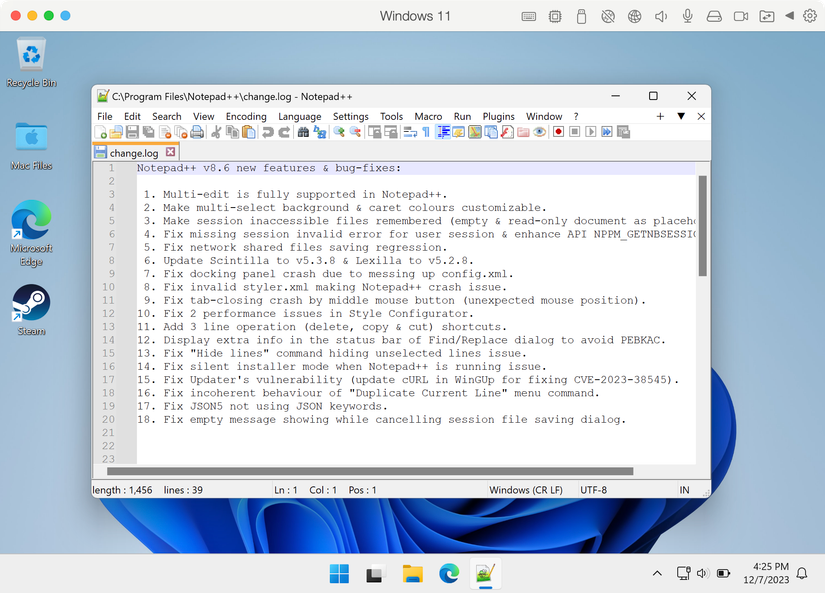
Notepad++ initially launched as a Windows-only application, and for much of its history, its development team focused solely on Microsoft’s platform. While the reasons for this exclusivity were not explicitly detailed, the outcome was clear: macOS users had to rely on workarounds like Wine or CrossOver, which emulated Windows APIs at the cost of performance and seamless integration. These methods, while functional, often introduced inefficiencies that made them less than ideal for daily use.
In early 2026, an independent group of developers, operating separately from the original project, created a fork under the GPLv3 license. Their approach involved rewriting the user interface layer in Objective-C++ and Cocoa while retaining the core Scintilla engine. The result was a Universal Binary compatible with both Apple Silicon and Intel Macs, eliminating the need for Rosetta translation and supporting macOS 11 and later. Though not an official release, this version represents the most comprehensive effort to bring Notepad++ to macOS, driven entirely by community initiative.
This scenario is not unprecedented, but it stands out because the port was spearheaded by users rather than the original developers. Open-source licenses like GPLv3 permit forks, but success depends on more than just legal permission—it requires a motivated community and a codebase that can be adapted without starting from scratch. Notepad++ met these conditions, offering a modular foundation and a dedicated user base that valued its lightweight design over alternatives like VS Code or commercial editors such as BBEdit.
What a Native Port Actually Changes
On Windows, Notepad++ gained popularity for its speed, minimalism, and extensive customization options. The macOS version preserves these strengths while aligning with Apple’s design principles. Menus, dialogs, and keyboard shortcuts now follow macOS conventions, and the editor supports native features like Dark Mode and system-wide spellcheck. The rewrite also addresses a long-standing security concern: the Windows version had a vulnerability in its updater that could execute malicious code, a risk avoided in the macOS adaptation due to its fresh codebase.

However, the transition is not without challenges. Localizations, such as the German version, exhibit inconsistencies that suggest they may have been generated with limited human review, a common issue in community-driven projects. More significantly, the plugin ecosystem remains incomplete. While a portion of the Windows plugins have been adapted, many remain unavailable, with no clear timeline for compatibility. For users who depend on specific plugins, this gap may limit the editor’s utility. The built-in Plugin Admin helps manage available options, but the broader ecosystem is still in development.
Performance, however, is not a concern. The Universal Binary runs natively on Apple Silicon, offering a noticeable improvement over emulated solutions. System requirements are modest, requiring macOS 11 or later, 4GB of RAM, and minimal storage. For developers who prefer lightweight tools, the macOS version of Notepad++ presents a compelling alternative to heavier editors, prioritizing efficiency over feature expansion.
The Broader Signal for Open-Source Software
Notepad++’s arrival on macOS is more than a long-awaited feature—it demonstrates how open-source communities can overcome delays or resistance from original developers. The project’s refusal to expand beyond Windows did not prevent users from creating their own solution; it merely postponed it. The GPLv3 license, which allows for forking, enabled this kind of innovation, even without the original team’s involvement.
This pattern is not unique to Notepad++. Other Windows-exclusive tools, from development environments to niche utilities, could follow a similar path if users demand it. The key factors include a permissive license, an engaged community, and a codebase that can be adapted without a complete overhaul. Notepad++ had all three: a loyal following, a modular architecture, and a license that permitted modification.
The port also underscores the limitations of community-driven efforts. Without the original developer’s participation, certain features—such as full plugin compatibility—may remain incomplete indefinitely. There is no assurance that the macOS version will receive the same level of polish or updates as the Windows original. The project is currently hosted on GitHub, where contributors can submit improvements, but its long-term viability depends on whether users find enough value to sustain it.
Who Gains—and What’s Still Missing
The macOS version of Notepad++ benefits three primary groups: developers who appreciate its lightweight interface, users transitioning from Windows seeking a familiar tool, and open-source advocates who view it as evidence that community-driven projects can fill gaps left by commercial software. For these users, the port eliminates the need for emulation, reduces system overhead, and integrates more smoothly with macOS workflows.

Yet it is not a flawless solution. The plugin ecosystem remains under development, and the lack of official support from the original team means no guarantees for future updates. Users who rely on specific plugins or require seamless cross-platform synchronization may still find the macOS version lacking. While the security improvements are a step forward, the rewrite does not address every potential vulnerability—only those inherited from the Windows codebase.
The broader question is whether this port signals a shift in how open-source tools approach cross-platform development. Notepad++’s macOS release suggests that users are no longer willing to accept platform exclusivity as inevitable. If a tool is valuable enough, the community will find a way to adapt it—even if the process takes years.
For now, the macOS version is available on GitHub, where early adopters can evaluate its stability and performance. It represents a milestone, but not the final chapter. The real test will be whether it can evolve beyond its origins—or if it remains a well-executed but unofficial adaptation of a Windows classic.


