
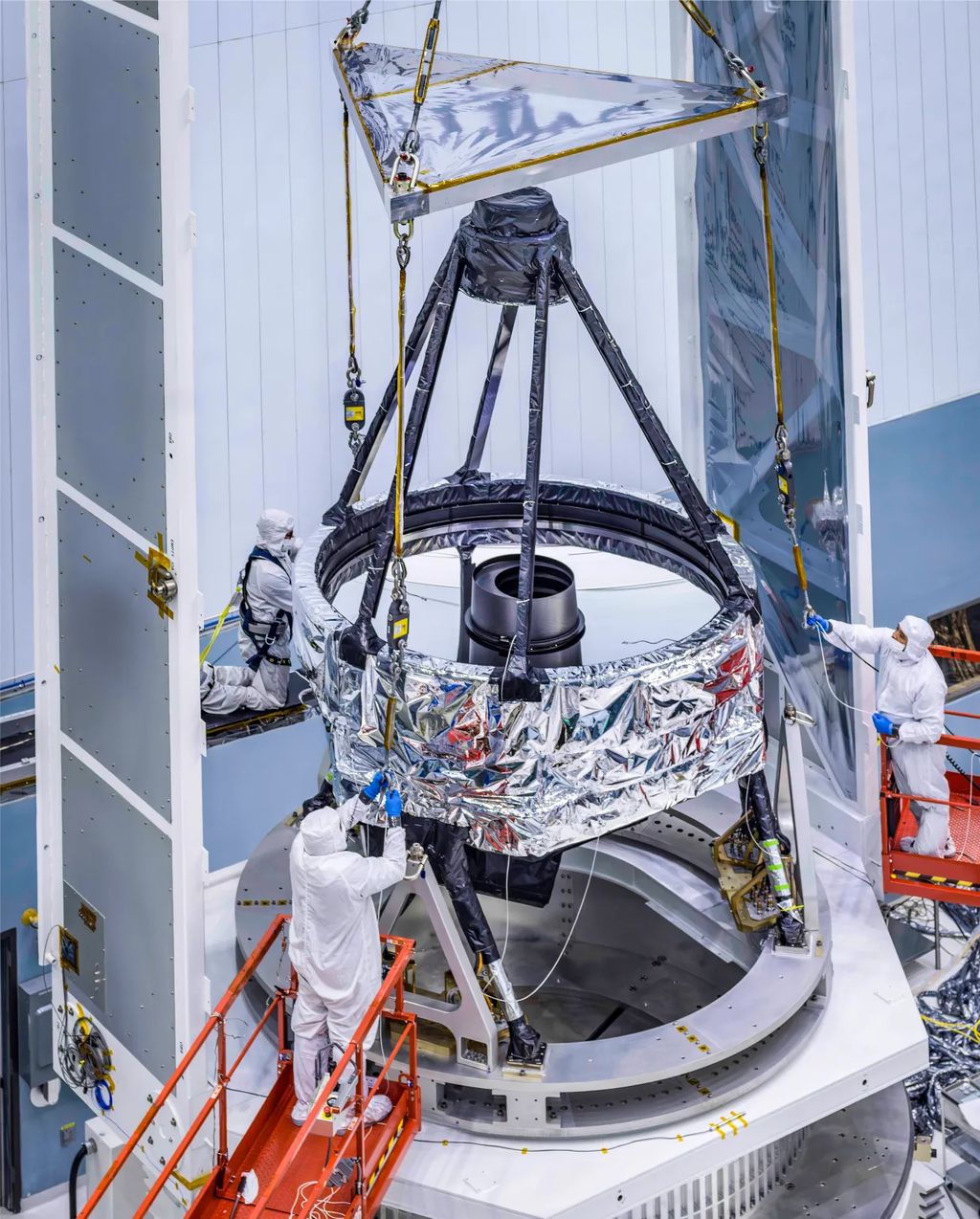
The Nancy Grace Roman Space Telescope, a $3.8 billion (3.5 billion euro) infrared observatory designed to hunt dark energy and survey exoplanets, is poised for launch as early as September 2026 — eight months ahead of schedule and under budget, according to NASA.
Built over more than a decade by over 1,000 technicians, the telescope — originally conceived as WFIRST — now bears the name of NASA’s first chief astronomer, Nancy Grace Roman, whose pioneering operate laid the foundation for the Hubble Space Telescope. With a 2.4-meter primary mirror matching Hubble’s size but a far wider field of view, Roman will capture infrared light across vast swaths of sky, enabling it to observe billions of galaxies, thousands of supernovae and countless stars in a single sweep.
Its dual instruments — the Wide-Field Instrument with 300.8 megapixels and a coronagraph designed to block starlight to reveal faint exoplanets — will allow scientists to study dark matter, map the universe’s expansion, and assess how common habitable-zone planets truly are. Unlike Hubble’s targeted observations, Roman is built for a systematic sky survey, a strategy that, as project scientist Julie McEnery noted, “opens space for new discoveries” by scanning not just what we know, but what we don’t.
NASA astrophysicist Jeremy Perkins captured the team’s mindset: “We will definitely find something we didn’t expect.” That anticipation of the unknown — not just confirmation of theories — drives the mission’s urgency. The telescope will generate 1.4 terabytes of data daily over its minimum five-year lifespan, building an archive of 20 exabytes that could reshape cosmology.
The launch will rely on a SpaceX Falcon Heavy rocket, underscoring the growing role of commercial partners in flagship science missions. If successful, Roman will join the James Webb Space Telescope in orbit, not as a replacement, but as a complementary surveyor — Hubble’s spiritual successor in scale, but with a gaze turned toward the universe’s deepest mysteries.
Historically, such early completions are rare but not unprecedented. When Hubble launched in 1990, it too faced delays and budget overruns; Roman’s ahead-of-schedule completion marks a contrast in execution, reflecting improved project management and international collaboration in large-scale space science.
The mission’s core ambition remains simple yet profound: to answer whether our solar system is typical or an outlier in a cosmos teeming with unseen worlds. By scanning the Milky Way’s stellar population in just one month of observations, Roman could create a stellar census unlike any before — a baseline for future generations of astronomers.
Why is the Nancy Grace Roman Telescope launching earlier than planned?
NASA reported that construction and testing progressed faster than expected, allowing the project to move up its launch window from mid-2027 to September 2026 while staying under budget.

How does the Roman Telescope differ from Hubble and James Webb?
While Roman shares Hubble’s 2.4-meter mirror size, its wide-field instrument captures vastly more sky per image; compared to James Webb’s larger 6.5-meter mirror optimized for deep infrared spectroscopy, Roman is built for broad surveys, not targeted deep stares.
Verwandte Artikel


