
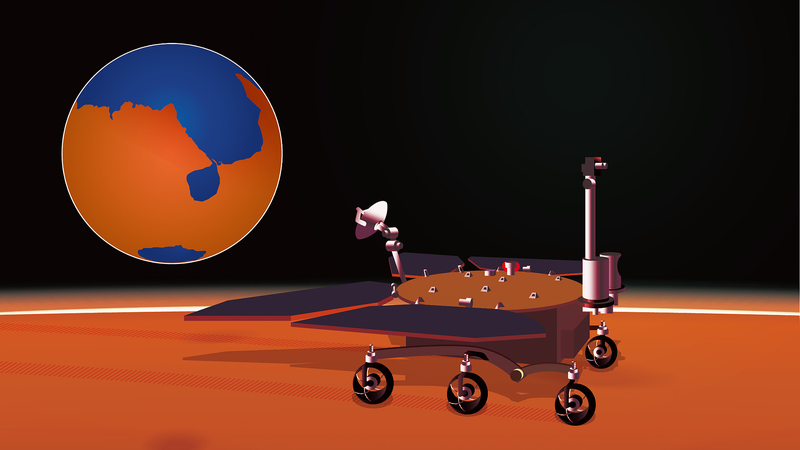
Caltech researchers identified a broad, flat landband in Mars‘ northern hemisphere as evidence of an ancient ocean that once covered about a third of the planet’s surface.
How the continental shelf was identified as key evidence
Scientists simulated what Earth’s topography would look like without oceans, finding the most prominent feature to be a ring-shaped continental shelf. They then searched for similar structures in Mars topographic data collected by orbiter missions.
Why the shelf is a more reliable indicator than shorelines
Unlike shorelines that shift with changing sea levels, continental shelves remain largely unchanged over geological timescales, making them stable markers of ancient oceans. The shelf’s longevity allows it to persist despite billions of years of wind, volcanic activity, and other erosive processes on Mars.

What additional evidence supports the ocean hypothesis
Along the identified landband, researchers found river deltas — triangular sediment deposits that typically form where rivers meet the sea. This spatial alignment strengthens the case for a past ocean by suggesting a former coastline where water and sediment once interacted.
When the ocean likely existed and disappeared
The ocean probably dried up several billion years ago, around the time Earth was still young. Since then, geological processes have erased many fine surface features on Mars, making the preservation of this large-scale structure particularly notable.
How did researchers know to look for a continental shelf instead of a shoreline?
They modeled Earth’s topography without oceans and observed that the continental shelf was the most stable and prominent feature left behind, making it a better long-term indicator of ancient water bodies than shifting shorelines.
Why is the discovery significant for understanding Mars‘ history?
It provides concrete geological evidence that Mars once had a sustained ocean covering a significant portion of its surface, which implies a warmer, wetter climate in the planet’s distant past and raises questions about its potential for ancient life.
Weiterlesen


