
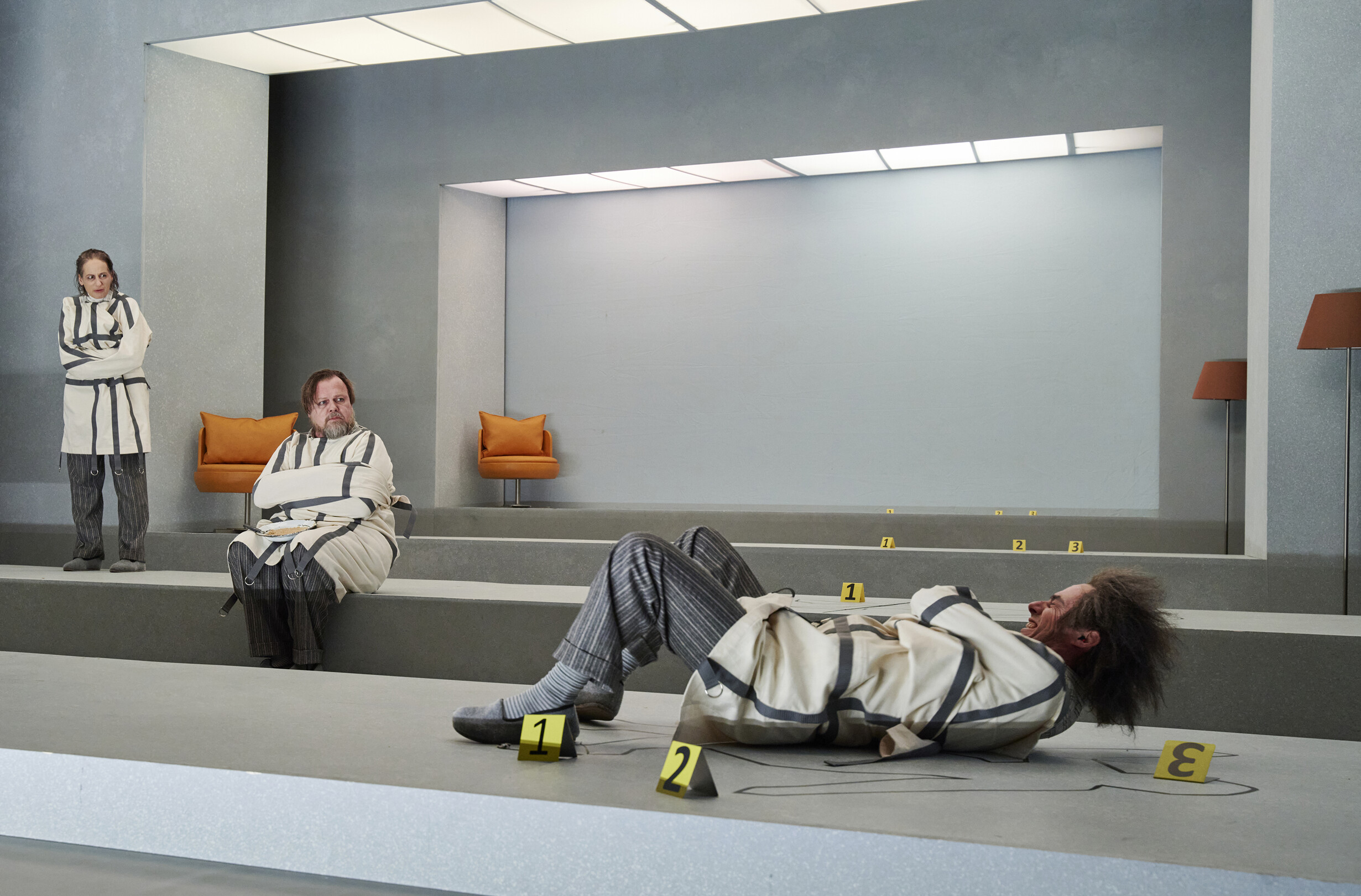
The premiere of Friedrich Dürrenmatt’s „Die Physiker“ at Berlin’s Deutsches Theater on April 25, 2026, arrived not as a historical footnote but as a jolt of recognition — a 64-year-old play about nuclear dread suddenly feeling less like allegory and more like a dispatch from the present.
Director Bastian Kraft’s production, staged in the intimate confines of the theater’s main house, strips away none of the original’s tension while amplifying its unease through deliberate staging choices. Ulrich Matthes, 66, takes on the role of Dr. Mathilde von Zahnd, the asylum’s director, in a cross-gender casting that adds a layer of unsettling authority to the character. The three physicists — Möbius, Einstein, and Newton — are portrayed by actresses, a decision Kraft leaves unexplained but which sharpens the play’s interrogation of identity and control within the asylum’s walls.
The narrative remains faithful to Dürrenmatt’s 1962 text: Möbius, having discovered a world formula capable of ending humanity, feigns madness to sequester himself in the sanatorium, only to find that knowledge cannot be contained. Three nurses are murdered for knowing too much, transforming what begins as a dark comedy into a chilling study of power, secrecy, and the illusion of safety. As Kronen Zeitung noted in its review, the murders are not loud or explosive — they are quiet, almost clinical, underscoring the play’s central irony: the true catastrophe unfolds not in detonations but in erasure.
The staging itself becomes a metaphor. Set designer Peter Baurs uses light and shadow to transform the stage from an apparently empty space into a labyrinth of concealed doors — the physicists’ rooms hidden behind seamless white panels. In the second act, the asylum shifts from refuge to prison; the walls close in, not through bars but through psychological and architectural inevitability. The characters’ true identities are revealed not in confrontation but over a shared bowl of liver dumpling soup — a moment of grotesque domesticity that exposes how easily ideology and allegiance can dissolve into farce under pressure.
What gives the production its urgency is not merely its faithfulness to the source but its resonance with contemporary anxieties. Both Bild and Die Zeit highlight how the play’s core question — who bears responsibility for dangerous knowledge? — has shifted from the atomic age to the era of artificial intelligence, where the stakes are no longer theoretical but operational. The Fronten haben sich verschoben, as Bild puts it, the systems are more complex, yet the dilemma remains: when knowledge can destroy, who guards it, and who decides when it should be used?
Die Zeit’s review adds a philosophical layer, noting that the play’s enduring power lies in its silence — the absence of gunfire or explosions makes the threat more insidious. The real horror, it argues, is not in the act of destruction but in the realization that humanity may have already built the mechanisms of its undoing, not through malice but through the quiet accumulation of capability without consensus.
The production does not offer answers. Instead, it holds up a mirror: a world where reason is weaponized, where asylum and prison are indistinguishable, and where the most dangerous secrets are not kept in vaults but in minds — protected not by walls but by the fragile agreement not to look too closely.
How the staging mirrors the play’s themes of confinement and revelation
The set design evolves from minimalism to entrapment, using false walls and shifting light to mirror the characters’ psychological deterioration. What begins as a sterile asylum becomes a maze with no exit, reinforcing the idea that the real prison is not the building but the knowledge they carry — and the fear of what happens if it gets out.
Why the cross-gender casting intensifies the drama’s psychological tension
By having Ulrich Matthes portray the asylum’s director and actresses play the physicists, Kraft destabilizes traditional power dynamics. The irony is not lost: the figure of ultimate authority is embodied by a man in a woman’s role, while the bearers of dangerous knowledge are women — a reversal that invites questions about who is deemed credible, who is confined, and who is allowed to speak truth.
What the play suggests about modern parallels to nuclear deterrence
While no weapons are detonated on stage, the underlying dread mirrors contemporary debates over AI governance, autonomous weapons systems, and the concentration of technological power in few hands. The play implies that the greatest risk may not lie in the use of such knowledge but in the inability to agree on its restraint.
Why did the director choose to cast actresses as the male physicists?
The sources do not specify Bastian Kraft’s reasoning for the cross-gender casting of the physicists, noting only that the decision remains unexplained in interviews and program notes.
Does the play offer a resolution to the ethical dilemma it presents?
No. Both reviews emphasize that Dürrenmatt’s work — and Kraft’s staging — deliberately avoids resolution, leaving the audience with the unsettling question of whether reason can prevent self-destruction or if humanity is destined to build its own asylum.
Verwandte Artikel


