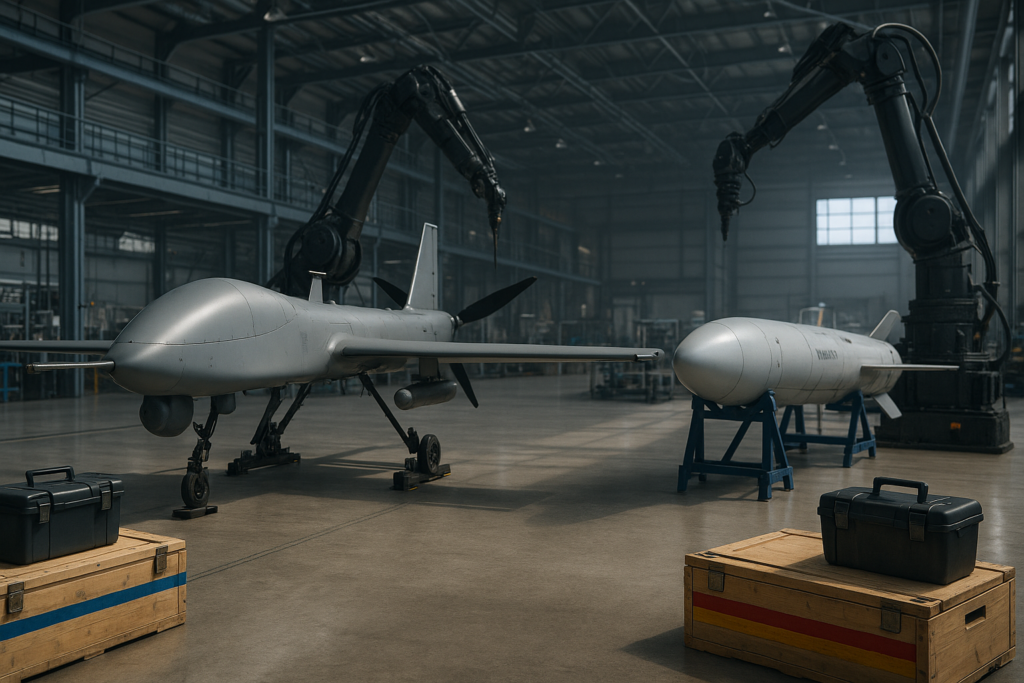
At a Berlin summit on April 14, 2026, Germany and Ukraine signed a defense cooperation agreement that includes joint production of drones and financing for hundreds of Patriot missiles, while the UK pledged to deliver at least 120,000 drones to Ukraine this year.
The accord marks the first government-level consultation between Berlin and Kyiv in over two decades, with Chancellor Friedrich Merz describing it as a strategic partnership aimed at strengthening European defense independence. Ukrainian President Volodymyr Zelenskyy called the drone initiative potentially „the largest deal of its kind in Europe,“ emphasizing that joint production would enhance continental self-reliance in critical defense systems.
Germany will finance a Ukrainian contract with Raytheon for several hundred Patriot missiles and coordinate with Diehl Defence on additional launchers for IRIS-T air defense systems. Both nations also agreed to establish a joint venture to produce thousands of medium- and long-range drones, alongside sharing combat data to develop new weapons systems.
Speaking at the same Berlin meeting, Ukrainian Defense Minister Mykhailo Fedorov reported that Russian losses had risen by a third recently, with 35,000 enemy personnel killed or wounded in March alone — 96% of those losses attributed to Ukrainian drone strikes. He underscored that drones are now decisive in shaping the war’s outcome.
For more on this story, see Germany summons Russian Ambassador over threats to defense firms.
The UK’s pledge of at least 120,000 drones for 2026 forms part of its £3 billion annual military aid package to Ukraine, including long-range strike, reconnaissance, logistics, and maritime-capable systems. Deliveries have already begun, with £150 million tied to NATO’s Prioritised Ukraine Requirements List, funding over 1,000 lightweight multi-role rockets manufactured in Belfast.
British defense officials noted the deal supports domestic drone manufacturers such as Tekever, Windracers, and Malloy Aeronautics, generating new jobs while reinforcing Ukraine’s battlefield capabilities. The systems pledged are already in combat use along the front lines.
Analysts note this level of coordinated drone production and delivery echoes the Western armor donations of 2023, when Leopard 2 tanks and Bradley fighting vehicles were pledged to counter anticipated Russian spring offensives — though the current focus on unmanned systems reflects a shift toward asymmetric, high-volume attrition tactics.
How will the German-Ukrainian joint drone venture affect European defense production?
The initiative aims to create a European-based drone manufacturing capability, reducing reliance on external suppliers and building industrial resilience in defense technologies critical to NATO’s eastern flank.

Why are Western nations prioritizing drone deliveries over other weapons systems?
Drones have proven highly effective in the current phase of the war, accounting for the majority of recent Russian casualties, and offer a scalable, cost-effective means to sustain pressure on invading forces while minimizing risk to Ukrainian personnel.
Weiterlesen