
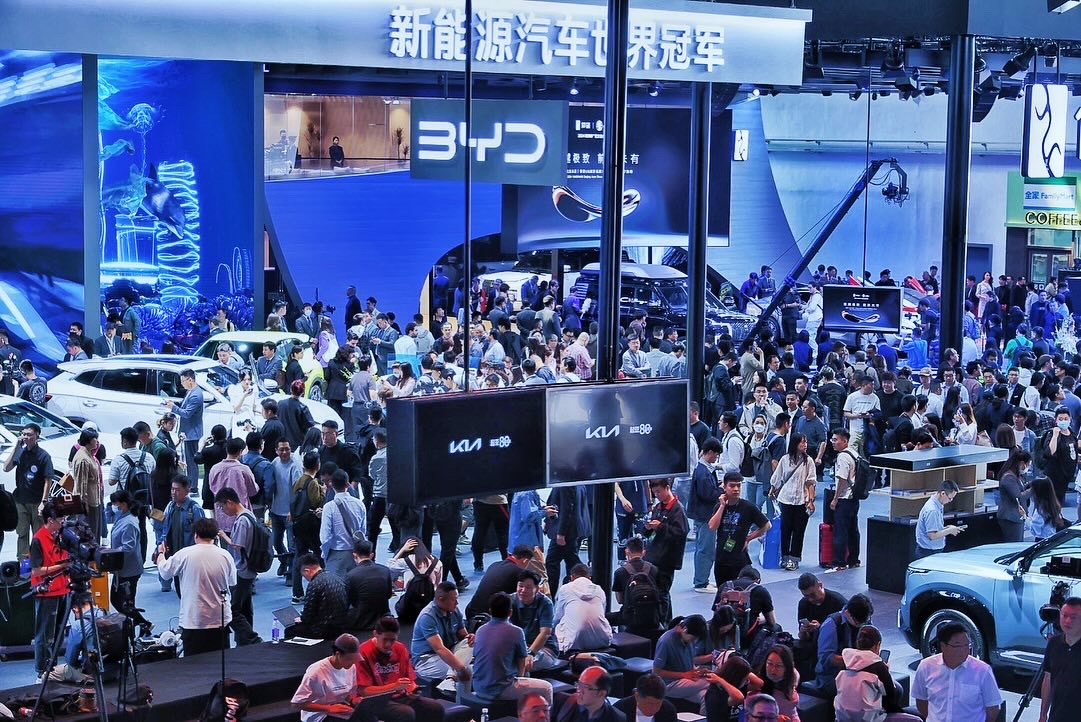
China’s auto industry showcased its global ambitions at the 2026 Peking Auto Show, unveiling over 180 new models and asserting dominance in electric vehicles, autonomous driving, and battery technology while Western manufacturers struggled to keep pace.
Chinese automakers presented more than 180 new vehicles, signaling expanded global reach
Domestic brands launched a wave of new models at the show, with several outlining ambitious international expansion plans. Geely, now China’s top-selling automaker, announced export targets exceeding one million vehicles for next year, with potential to reach 1.5 million soon after. The company hosted a gala featuring a seven-course meal for guests, underscoring its confidence in scaling beyond home markets.
Xiaomi recruited top German engineering talent for its Munich development center
The electronics giant, which began selling cars two years ago, revealed it had poached a dozen established developers and designers from BMW, Audi, Porsche, Lamborghini, and Mercedes for its Munich facility. CEO Lei Jun confirmed the hires himself, highlighting Xiaomi’s aggressive push into performance and design credibility through direct acquisition of Western expertise.
BYD demonstrated Siberian-ready battery technology in a sub-zero charging test
The Shenzhen-based conglomerate dedicated an entire hall to its technology, including a cold chamber where vehicles were frozen to minus 30 degrees Celsius. BYD aimed to prove its batteries could achieve a full charge in twelve minutes under such extreme conditions, addressing a key barrier to EV adoption in frigid climates. Despite leading China’s market last year, BYD has faced a sales slump since summer, which its earlier autonomous driving systems failed to reverse.
Western automakers appeared as observers, struggling to match Chinese innovation
Foreign brands, particularly German manufacturers, often resembled spectators at the event, reviewing what they had missed. One German executive told the F.A.Z. After touring the halls: „Now I have work orders for another six months.“ The comment reflected a growing realization that the pace of innovation in China now sets the global benchmark, with competitors forced to react rather than lead.
Chinese brands moved aggressively into premium and performance segments
Domestic makers challenged established luxury and supercar hierarchies. Dreame, known for vacuum cleaners, announced plans for a sports car exceeding 2,000 horsepower. Avatr unveiled a nearly seven-meter-long vehicle with a panoramic glass roof, signaling futuristic design ambitions. Meanwhile, Maybach faced pressure from the Maextro S800, a Huawei-powered model reportedly outselling all German luxury limousines combined.

Volkswagen pursued a „China for China“ strategy with localized models
While foreign brands largely relied on facelifts and long-wheelbase versions, Volkswagen emphasized its China-specific lineup, including the Unyx, Era, and Aura models. Even the Jetta received a redesign to appear more stylish and affordable, reflecting the pressure to adapt to local tastes rather than impose global standards.
Surprise strength emerged in hybrid combustion technology
Geely introduced a hybrid vehicle claiming a 2.2-liter-per-100-kilometer fuel consumption, potentially setting a world record. The development highlighted that China’s advancements extend beyond electrification into efficient internal combustion, complicating assumptions about the future of powertrains in the region.

Why did Western journalists receive limited access to the show?
Chinese automakers invited hundreds of Western bloggers and specialist journalists to hotel previews and factory visits, but major newspaper reporters were rarely included or denied visas and accreditation altogether, suggesting a selective outreach strategy favoring influential digital voices over traditional media.
What does the Maextro S800’s reported sales performance indicate about shifting luxury preferences?
The Huawei-powered Maextro S800 reportedly outselling all German Oberklasse limousines combined signals growing consumer trust in Chinese-tech luxury vehicles, challenging long-standing assumptions about brand supremacy in the premium segment.
Weiterlesen


